
My Journey as a Teacher and Writer
About Me
With a passion for travel, writing, and teaching, I have immersed myself in all three fields over the years. However, my experience of living in China has enriched my creative process and allowed me to share unique perspectives through my writing and teaching. As a TEFL teacher with my own bespoke brand of LEARN English, I find great reward from helping learners unlock their potential in mastering the English language.
A Journey of
Discovery
Whether you're interested in creative writing, language teaching, or travel stories, I invite you to join me as we explore these fascinating subjects together.
Everyone is welcome!
English classes for all ages and abilities.
Whether you're just starting out on your journey, or already learning English at school, or even studying for final exams, our Learn English classes will have something to offer everyone.

Speak fluently
Lessons focus on the spoken word in conversational settings. Students learn to speak English the way it is meant to be.

Read fluently
Students develop their English vocabulary and language skills through one-to-one support.

Write fluently
Students are helped to develop their handwriting skills, spelling, and punctuation.
01
Designed for learners aged 5 to 11 years
Primary Education Teaching
Lessons are organised according to the levels of the Common European Framework of Reference for languages (CEFR). Activities give students an opportunity to develop their English language and skills in motivating and enjoyable ways. Activities aim to give students the skills and confidence they need to enjoy learning English.
02
Designed for learners aged 12 to 17 years
Secondary Education Teaching
- Pre-intermediate Lessons (A2)
- Intermediate Lessons (B1)
- Upper-intermediate Lessons (B2)
- Advanced Lessons (C1)
03
Designed for learners 18 years and older
Adult Education Teaching
Lessons taken from:
- Intermediate B1
- Upper intermediate B2
- Advanced C1
Also includes teaching IELTS candidates an test takers.
Make your English work for you!
Discover more about our extensive range of English Specialisation courses. We constantly update this page, but if you still can’t find what you’re looking for, please feel free to get in touch with us – we will be more than happy to help.

Basic English
A1/A2 Specialisation
What you'll learn
Improve vocabulary, use basic grammar, express ideas and narratives, and increase confidence in listening and speaking in English.
Skills you'll gain
Oral Comprehension - Literacy - Grammar - Vocabulary - Verbal Communication Skills - Language Competency - English Language - Language Learning
English Intermediate
B1 Specialisation
What you'll learn
Relevant vocabulary and grammar at the Intermediate level. Specific language skills for the workplace, especially effective spoken and written communication. Language in a series of practical work-based tasks.
Skills you'll gain
Formal Learning - Communication - Writing - Oral Comprehension - Negotiation - Grammar - Presentations - Report Writing - Interpersonal Communications

English Upper Intermediate B2.1
What you'll learn
Vocabulary and grammar for effective communication in the workplace. Essential skills to operate effectively in an English-speaking work context.
Skills you'll gain
Intercultural Competence - Trend Analysis - Vocabulary - Oral Comprehension - Advocacy - Environmental Issue - Grammar - English Language - Interpersonal Communications - Culture - Descriptive Statistics

English Pre Advanced
B2.2
What you'll learn
Advanced-level competency in English communication for life or the international workplace. Effectively analyse and produce complex written and spoken discourse. High-level comprehension skills to understand diverse texts and media in professional and social contexts. Cultivate confidence in using English for real-life scenarios, including travel, work, and relationships.
Skills you'll gain
Communication - Journalism - Cultural Diversity - English Language - Vocabulary - Grammar

English Advanced
C1
What you'll learn
A broad range of sophisticated language structures to express ideas, opinions and emotions and participate confidently socially and at work. Sophisticated and broad lexis, including colloquial language, to discuss broad-ranging abstract topics around art, music, diet and finance. Understanding longer authentic written and spoken texts.
Skills you'll gain
Oral Comprehension - Vocabulary - Language Competency - Environmental Issue - Grammar - Literacy - Oral Expression - Writing

Business English
Specialisation
Build English Skills for Business. Improve your ability to speak, write and understand English in professional settings.
What you'll learn
Learn to communicate about topics such as management, finance and marketing. You will write proposals, executive summaries, and marketing materials. You will learn the necessary language structures to run a meeting, achieve sales, and negotiate other business transactions. You will gain a variety of linguistic tools with practical applications in business scenarios in a variety of functional areas.

Essential English for University Success Specialisation
Excel at any English-Speaking University. Sharpen speaking, writing, and study skills necessary for university success.
What you'll learn
This three-course specialisation is intended for anyone who is preparing to study in a university in an English-speaking country, or who might do so in the future. Through courses focusing on the speaking, writing, and study skills needed for university success, you will gain knowledge and strategies that will prepare you to succeed in university classes.

Advanced Academic Speaking & Listening Specialisation
Speaking and Listening Skills for Academic English. Learn to speak and listen more effectively.
What you'll learn
Listening and speaking skills that non-native English-speaking students need to be successful in English-speaking colleges and universities. Native English-speaking students who would like to increase their chances of success in university courses will benefit from improving their listening comprehension skills. Learn to listen to class lectures and take notes more effectively. Improve your speaking skills for common tasks such as class discussions and presentations.

Teach English: Intermediate Grammar
Specialisation
For ESL teachers and future ESL teachers who want to make their classes more effective and fun; giving teachers creative ideas for the classroom.
What you'll learn
Use of online resources to enhance intermediate grammar lessons for students.
Use of online videos and activities that ESL teachers at University of California created to teach intermediate ESL learners.
Review of language-learning pedagogy and best practices for using these resources effectively.
IELTS
The International English Language Testing System
The IELTS is an English Language proficiency test. There are more than 4 million test takers every year, making it the world’s most popular English language proficiency test for higher education and global migration.
IELTS Teacher
In supporting dozens of test-takers every year in their ambitions to study, work, or live life in an English speaking country, I provide a range of support to English learners wishing to take the IELTS test, including training courses, videos, scoring guides, and sample tests. I provide everything needed to succeed!
How does IELTS work?
IELTS is aimed at people who want to study in an English-speaking environment, work in or emigrate to an English-speaking country, or get a job in a country where English proficiency is required. There are two tests to choose from:
- IELTS Academic (university acceptance, visas, proof of ability).
- IELTS General Training (measures English proficiency levels).
IELTS Teacher
Why choose IELTS?
IELTS focuses on real-world communication skills and offers a number of important benefits:
- Access new opportunities.
- Advance your career.
- Work internationally.
- Settle in an English-speaking country.
- Choose a test that suits your needs.
- Be confident in your results.
- IELTS is accessible to everyone, including those with special needs.
Can IELTS help with visas?
Immigration authorities in many English-speaking countries ask for proof of English language proficiency as a condition for being granted a visa. IELTS provides this proof.
- After completing an IELTS test, you will receive an official Test Report Form (TRF).
- Your TRF is valid for two years and should be submitted to visa authorities.
- Each visa has its own IELTS score requirements. Confirm what score you need.
Compare IELTS to other tests
IELTS provides the flexibility of taking the test on paper or on computer, catering to individual preferences.
IELTS Academic assesses English skills for academic environments, while IELTS General Training also tests for everyday language.
IELTS tests all key English skills and has a wide recognition, with more test availability throughout the year.
IELTS testing is more comprehensive and remains the gold standard for institutions and immigration departments around the world.
Teaching IELTS
Everything learners needs to succeed.
As an IELTS Teacher, my role is to guide my students through their tests using a range of proven techniques in a way that maximises their chance of success.
Choosing the right IELTS test is crucial for students and very much depends on where they want to go next, especially if they want to emigrate to the UK and need an English test as part of their application to UK Visas and Immigration.





What makes teaching English in China so good?
Having spent the whole of my life working in science and engineering in the UK, moving to China was a massive leap of faith! Especially when I speak very little mandarin and knew very few people. On first arriving in Anshan, life was a bit like living in the movie “The Matrix”. Nothing, literally nothing, about China made any sense whatsoever and my psychological compass needle, the one that usually always points true north, was spinning out of control.
It's taken time to settle in
It took almost three months before one day, as I sat in the back of a taxi on a short three-mile journey from our apartment in Tiedong District to Anshan city centre, I began to see clearly. It no longer mattered that I couldn’t understand Chinese writing. I could see and meet people and, in many cases, even speak a little English. No drama. My confidence returned as I begin to embark on journey of cultural discovery like never before.
It's clear to me that I’ve been given a unique opportunity to experience, first hand, the nation’s culture, learn a new language, and travel extensively throughout a rapidly developing country with a 5,000-year history and immense natural landscapes. What more could anyone ask for?
It's a privilege to be invited into the lives of some of the most generous, kind- hearted, honest, hard-working, life-loving people I’ve ever met. Teaching English in Anshan has been, and remains, one of the most rewarding experiences of my life.
Life in China is tough and no one gets an easy ride. With a population of more than a billion, employment competition in China is considerable. Ergo, competition for the education necessary to access worthwhile employment is correspondingly high.
Education is not optional
Like so many other inventions, the Chinese invented the graded school system. Formalised during the Song dynasty (960-1279 A.D.), the grading system represented a big step in the large scale structuring of education. However, education in China dates back much further. Confucius is known for starting the tradition of private education, and Wen Weng founded the first public school during the Western Han Dynasty (202 B.C.-25 A.D.).
Today, starting at six years of age and finishing at twelve, compulsory education begins with elementary (primary) school where children are provided with fundamental reading, writing, and mathematics skills to establish a solid foundation for learning at the next level. This is followed by three years of middle school, then finally three years of senior high school before an offer of university study for those that wish to progress to higher education.
The average class size for both primary and secondary school pupils in China's inner cities is 50-60 with up to 1000 children in each grade 1-9.
In middle and high schools, each core subject involves a test at the end of every month. Test results tables are then ranked before being published.
Stepping up to the challenge
Parents recognise that the pressures of academic achievement begin to mount at the start of middle school and the perception is, that in order to gain a small advantage, or rather not lose pace in the race, parents widely invest a great deal of time and money in after-school classes.
Long days in the school classroom are followed by two or three hours of after-school studying, followed by two hours of school homework every day. Pupils start off their day usually around 7.40am (6.50am if they choose to participate in extra-curricular sports activities), and often arrive home at 9pm or later. Even weekends are spent, in part at least, taking after-school classes.
In the West, pupils would be easily forgiven if they complained about such workloads, but I’ve witnessed nothing but steely determination to taking on and overcoming these significant daily challenges because they are taught from an early age that results only come through hard work and commitment.
School test results matter a lot to both pupils and parents and much attention is given in preparation. That said, China's schools encourage excellence in all aspects of development, not just those on the academic curriculum but also the arts and sports.
Doubling down on fees
After-school classes are categorised into supplementary academic classes that focus on academic subjects, and interest-based classes that cover subjects such as art, music, and sports etc. but a recent (2021) government policy, known as the "Double Reduction" policy, has had an impact on after-school education, especially the core subjects, Chinese, Maths, and English, included.
The policy aims at reducing academic workload and financial burden on families by curtailing profit-making tutoring in core curriculum subjects for Grades 1-9. It effectively places a ban on after-school tutoring in core subjects; making it illegal for privately owned companies to offer these classes in return for a fee, although voluntary teaching is still permitted under Policy rules.
While academic tutoring has been restricted, in principle at least, interest-based extracurricular activities have generally been unaffected. Many parents however, believe that the policy has caused them to turn more to private tutoring, as they continue do all they can in seeking academic support for their children. The fact that parents push so hard, even at the pre-school (kindergarten) age, shows just how much importance is placed on spoken English in modern China.
Applied Teaching Resources
Starting with common words and short phrases, lessons are organised and designed to expand into longer and more complex studying. Learners are given the opportunity to develop their English language skills of reading, writing, listening, and speaking in motivational and interesting ways. Below are examples of some of the reading resources used.
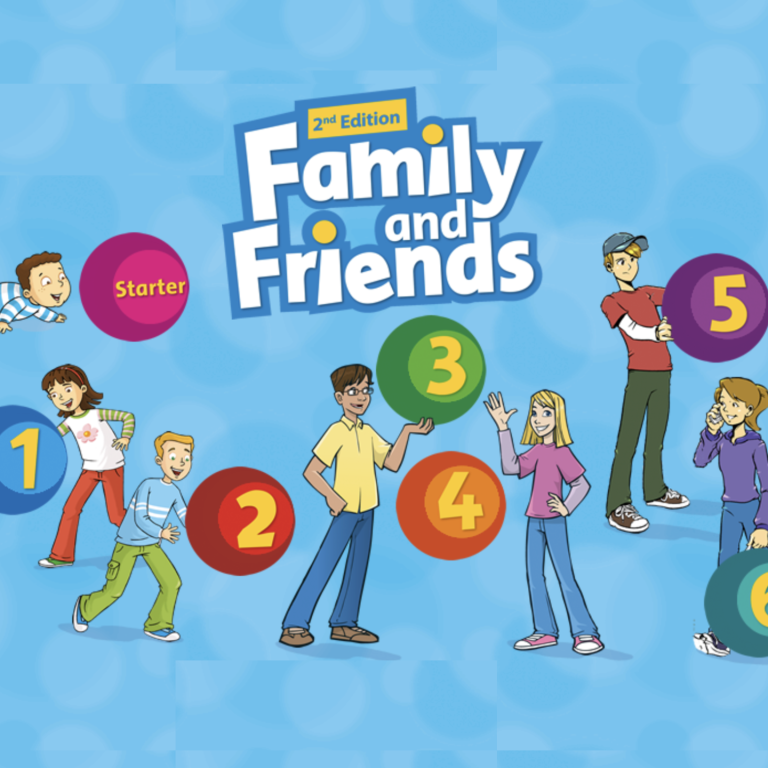
Beginners
Family and Friends combines fluency, culture, assessment, and digital resources with fast-paced language, strong skills training, unique phonics programme, civic education and comprehensive testing.
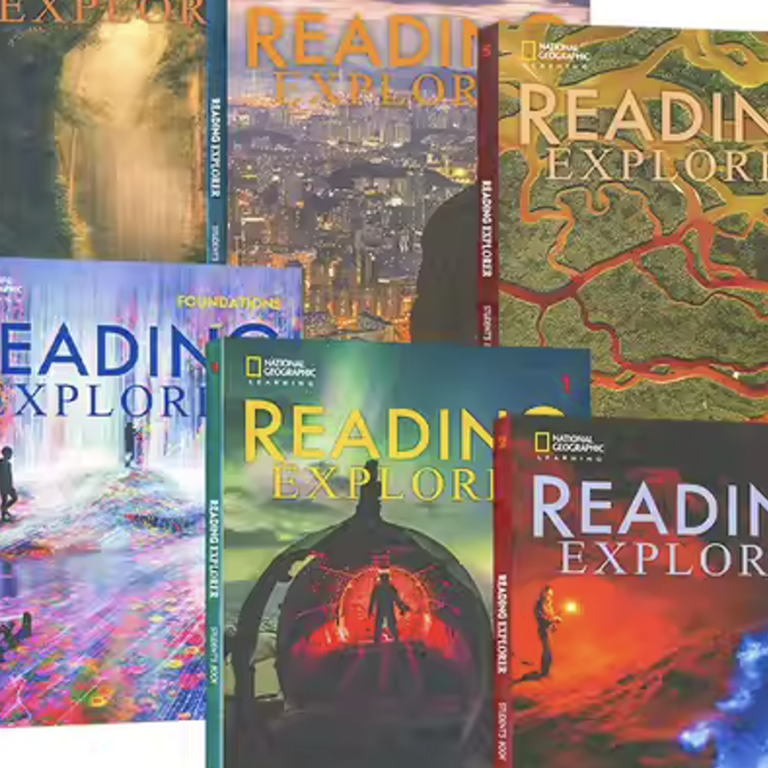
Intermediates
Reading Explorer, a progressive six-level reading series, prepares learners for academic success with highly visual, motivating National Geographic content that features real people, places, and stories. Just brilliant!!
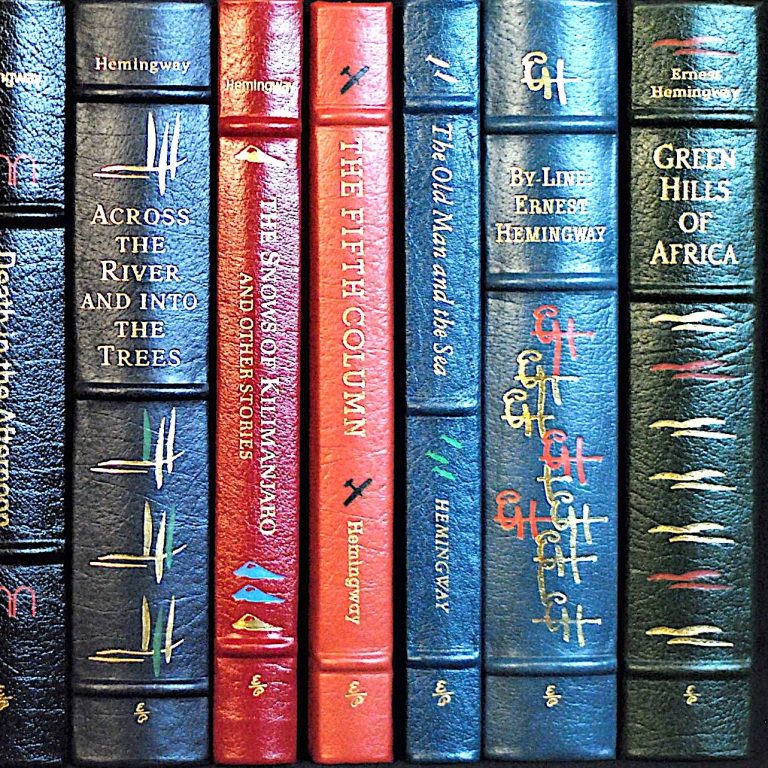
Advanced
Novels such as The Old Man And The Sea by Ernest Hemingway and The Harry Potter Series by J.K. Rowling go beyond basic recall and summary to engage learners with the text on a deeper level. Challenging but very enjoyable.